
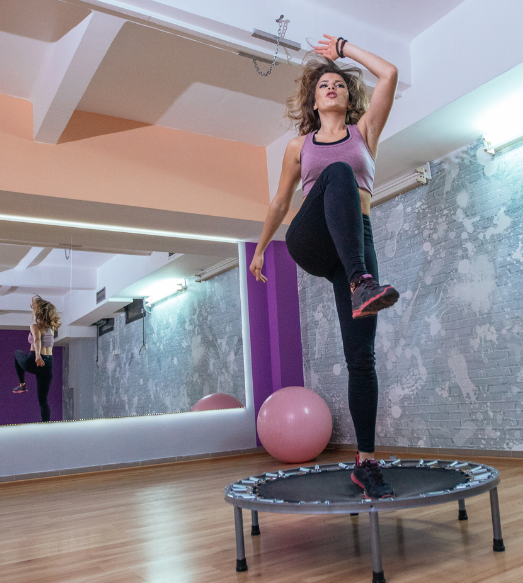
The fitness industry has long equated intensity with results, pushing narratives of harder workouts, longer sessions, and maximum effort as the only path to transformation. But a quieter shift is underway, driven by a growing understanding of longevity, hormonal health, and what it actually takes to sustain movement across decades of life. For Colette Dong, co-founder and CEO of The Ness, this shift isn't theoretical—it's the foundation of her company.
In this episode of The Growth Layer, Colette shares how she and co-founder Allie Gomes Polo built a dance-based trampoline fitness method that blends choreography, functional training, and evidence-backed science. We discuss why trampoline workouts (rebounding) are three times more efficient than running, how The Ness scaled from a single New York studio to a thriving digital platform, and what Colette learned about marketing missteps, founder hubris, and the fundamentals that can't be hacked.
The Origin: Performers Looking for Cross-Training
Colette and Allie both grew up as dancers—ballet, contemporary, modern—and pursued formal training in dance teaching, dance science, and exercise science. They met while performing in New York City, working on a high-impact immersive theater production that involved running between stages, jumping on boxes, and climbing walls. The show was physically demanding, and they needed a way to cross-train that wouldn't compound the stress on their bodies.
Dance, while beautiful and expressive, is inherently anaerobic. Performers sprint for three minutes on stage, then spend time backstage changing costumes or watching from the wings. The cardio component is inconsistent, and the impact can be taxing. Colette and Allie wanted something that would push their cardiovascular systems without working against their dance training.
They discovered a studio using trampolines and were immediately hooked. The equipment felt good on their joints, offered serious intensity, and provided the kind of sustained cardio they were missing. When it came time to transition out of performance and into the next phase of their careers, they knew they wanted to bring trampolines to a wider audience.
The idea wasn't just about offering another fitness class. It was about designing a method that honored their dance roots—making movement feel like play, like community, like something people would want to return to again and again.
Why Trampoline Training Works: The Science Behind Rebounding
Trampolines aren't just visually engaging; they're remarkably effective. NASA conducted studies on rebounding to help astronauts transition from zero gravity back to Earth's gravitational pull. The goal was to rebuild bone density without excessive impact. What they discovered was that rebounding is three times more efficient than running. Whatever energy someone would burn in 30 minutes of running, they achieve in 10 minutes on a trampoline.
This efficiency matters for busy professionals, parents, and anyone trying to build sustainable fitness habits. Ten minutes is manageable. Ten minutes fits into real life. And when something fits, people actually do it.
Beyond efficiency, trampoline training offers a range of benefits that align with the growing focus on longevity and functional fitness:
Joint health: The trampoline surface absorbs impact, reducing stress on knees, hips, and ankles. This makes it accessible for people who can't tolerate high-impact activities like running or traditional HIIT.
Lymphatic drainage: The up-and-down motion of bouncing stimulates the lymphatic system, which doesn't have a pump like the circulatory system. Movement is what keeps lymph flowing, supporting immune function and reducing inflammation.
Pelvic floor strength: Every bounce mimics the contraction and relaxation pattern of the pelvic floor, which is especially valuable for postpartum women or anyone working to rebuild core stability.
Bone density: Weight-bearing activity builds bone, and the G-force generated on a trampoline provides that stimulus without excessive strain.
Proprioception and balance: The unstable surface requires constant micro-adjustments, improving coordination, balance, and body awareness.
These benefits position trampoline training as a tool not just for fitness, but for wellness across the lifespan.
The Longevity Shift in Fitness
Colette notes that the conversation around fitness has evolved significantly in the seven years since The Ness launched. People are thinking more seriously about longevity—not just living longer, but maintaining quality of life, mobility, and vitality into their 60s, 70s, and beyond.
This shift has changed what people are willing to try. The narrative that once dominated women's fitness—do three hours of cardio, avoid weights, go harder—is being replaced by a more nuanced understanding. Less can be more. Intensity doesn't have to mean impact. And movement should be something you can sustain, not something that breaks you down.
Women in particular are becoming more attuned to how hormones interact with exercise. High-intensity training at the wrong phase of a cycle, or without adequate recovery, can dysregulate stress hormones and negatively impact energy, mood, and metabolic health. Low-impact options like trampoline training offer intensity without the cortisol spike, making them hormone-friendly and sustainable.
Colette also observes that people are looking for modalities they can do into their later decades. The question isn't just "Will this give me results now?" but "Can I still do this when I'm 65?" That long-term thinking changes how people evaluate fitness options and why they're more open to methods like rebounding that prioritize joint health and functional movement.
Who The Ness Serves: High Performers and Community Seekers
The Ness attracts a wide demographic range, from women in their mid-20s to those in their 60s and beyond. Some members started in their 50s and are still bouncing regularly a decade later. While the classes skew female—partly because women tend to be more open to class-based fitness and dance-inspired formats—men are absolutely part of the ecosystem.
Beyond demographics, Colette identifies a personality thread that runs through The Ness community: high-performing individuals who are willing to be bad at something. Trampoline training isn't easy on the first try. The coordination, the balance, the choreography—it all requires practice. The people who stick around are those who embrace the challenge, who are motivated to improve, and who find satisfaction in mastering something new.
These tend to be successful, driven people who are balancing demanding careers and family lives. They're not looking for a workout that wastes time. They want efficiency, results, and an experience that feels engaging rather than punishing.
The community aspect is also central. The Ness cultivates a "dance studio vibe" where members know each other, make connections, and share recommendations. It's the kind of organic, person-to-person trust-building that social media has partially replaced but that people still crave.
Colette describes it as "for the girls, by the girls"—a space where women are jamming out together, learning choreography, and supporting each other.
Scaling the Business: Studio Roots and Digital Growth
The Ness started with a single studio in Tribeca. For the first few years, the focus was on optimizing that one physical space: fitting as many classes as possible into peak hours, filming content between sessions, managing private training, and hosting live streams. It was a classic service business constraint—you can only scale as far as your time and space allow.
When The Ness launched its online app, Colette was skeptical. She didn't believe the in-person experience could be replicated digitally. She resisted getting on camera, resisted filming, and couldn't imagine how people would learn trampoline choreography from home. But the response proved her wrong.
People were far more willing to try at home in a private, low-pressure setting. The digital platform removed barriers to entry—no commute, no self-consciousness, no need to coordinate schedules with a studio's availability. It also unlocked scalability. While Colette was conducting an interview or managing operations, 200 people might be doing her video that morning.
The digital side quickly became the primary revenue driver. At one point, the split was 80/20 digital to in-person. Over recent years, it hovered around 70/30. With the opening of a new, larger studio—designed to handle filming, classes, privates, and meetings simultaneously—the balance has shifted closer to 60/50.
The new studio serves as both a content production hub and a physical community space. It allows The Ness to continue growing the in-person experience while supporting the content pipeline that fuels digital growth. The plan moving forward centers on the app and on-demand classes, which remain the most scalable part of the business.
Currently, The Ness offers over 1,000 on-demand videos, with two new classes added every Monday. Members also get unlimited live streams, meaning they can tune into classes happening in New York even if they're across the country. Programs like January challenges, spring resets, and themed series (like "Mixtape" in October) keep users engaged throughout the year.
Differentiators: Equipment, Price, and Community
In a crowded fitness market, differentiation matters. The Ness has several clear advantages, starting with the equipment itself.
From a home fitness perspective, trampolines are more accessible than many alternatives. At $449 retail, they're significantly cheaper than treadmills or high-end stationary bikes, which often start at $2,000 or more. They're also space-efficient. A trampoline can fit in a small apartment, be moved to a backyard, or stored when not in use. Assembly is straightforward, maintenance is minimal (replacing cords occasionally), and there aren't many mechanical parts that can fail.
Yet trampolines offer far more versatility than lighter equipment like resistance bands or dumbbells. They provide balance training, stability work, cardio, proprioception, and the lymphatic and pelvic floor benefits mentioned earlier. It's a single piece of equipment that serves multiple functions, making it a high-value investment.
In the physical space, The Ness differentiates through community and culture. The studio feels less like a transactional gym and more like a gathering place. Instructors facilitate connections between members, help people find common ground professionally or personally, and create an environment where word-of-mouth thrives. That organic referral network is invaluable in a city like New York, where competition is fierce and attention is fragmented.
Founder Lessons: Marketing Missteps and Strategic Hubris
Colette is refreshingly candid about what drove her to become a founder. Part of it was strategic hubris—the belief that she could do things better than the studios she and Allie had worked for. They saw gaps, inefficiencies, and missed opportunities. They wanted control over their creative vision and career trajectory. They didn't want to navigate approval layers or come up against roadblocks imposed by others.
But Colette also acknowledges the less polished version of the founder story: sometimes your back is against the wall. Companies fold, opportunities disappear, and the universe pushes you off the ledge. If you have the confidence to believe you can figure it out, you end up building something.
One of the hardest lessons came from a marketing misstep early on. The Ness entered into a brick-and-mortar retail partnership with a multi-brand space—essentially a curated mall for independent brands. It seemed exciting, high-visibility, and worth the investment. But Colette didn't have expertise in performance marketing, and she didn't ask the right questions upfront.
The company promised 30,000 touchpoints, strong foot traffic, and consistent sales conversions. But they couldn't provide KPIs or reporting to back those claims. Colette didn't know to ask for references or to validate the partnership with other brands who had participated. The investment turned out to be a waste—a significant amount of money with minimal return.
She reflects on this as a humbling moment. As a founder, you end up doing things outside your expertise. You operate, you train, you build—but you're not necessarily a marketer, a finance expert, or a legal strategist. The mistake taught her to ask for help sooner, to seek guidance from people who have domain knowledge, and to validate assumptions before committing resources.
It's also a reminder that in marketing, experimentation is necessary. You don't always know what will work. But you can reduce risk by doing diligence, asking questions, and learning from others who've walked the path before you.
Retention and the Three-Month Threshold
Retention is the lifeblood of any subscription-based fitness business. For The Ness, the critical threshold is three months. If a user makes it past that point, they often stay for years.
This pattern reflects a broader truth about habit formation and skill acquisition. Trampoline training requires education. People worry they'll fall, they'll lose control, they'll embarrass themselves. The first few sessions can feel awkward. But once users push through that initial learning curve and start to feel confident, comfortable, and capable, the experience transforms. Their relationship with their bodies changes. Their approach to movement shifts. And they become loyal members of the community.
The challenge is getting people to that three-month mark. Colette is open about the fact that The Ness is still refining its approach to education and onboarding. Organic social media helps—short-form videos that show the simplicity and accessibility of the movements. Celebrity and influencer endorsements add social proof. But none of it matters if the retention infrastructure isn't in place.
Colette describes unexpected growth as both a blessing and a problem. When subscribers surged faster than anticipated, The Ness didn't have the systems in place to educate, nurture, and retain them. It's like pouring water onto a table without a container to catch it. Now, the company is actively building those systems: email sequences, SEO content, blog posts, and onboarding flows that guide new users through their first experiences.
The Fundamentals You Can't Hack
One of Colette's most memorable insights is her analogy between marketing and living well. You can't hack your way out of good sleep, good nutrition, and consistent exercise. Those are the pillars. Similarly, in business, you can't growth-hack your way past solid email marketing, strong SEO, and functional retention systems.
Founders are constantly sold on shortcuts, on silver bullets, on strategies that promise outsized returns with minimal effort. But sustainable growth—like sustainable health—comes from mastering the fundamentals and practicing them consistently.
For The Ness, that means investing in the boring, essential work: nurturing email subscribers, creating valuable content that ranks in search, building funnels that convert and retain, and ensuring that every touchpoint reinforces trust and value.
It's not flashy. It's not exciting. But it's what works.
What's Next
The Ness continues to prioritize digital growth. The app, the on-demand library, and the live stream integrations are where the company sees the most scalability. The new studio supports that growth by functioning as a content production hub, allowing The Ness to film consistently without disrupting classes or private training.
Colette and her team are also focused on refining the education and onboarding experience. The goal is to reduce friction for new users, help them understand what trampoline training offers, and guide them through the first few weeks until they've built enough confidence and competency to stick around.
Longer-term, The Ness will likely continue exploring partnerships, community-building initiatives, and ways to deepen engagement both online and in-person. The brand's strength lies in its ability to make movement feel joyful, sustainable, and social—and that ethos translates across platforms.
Why This Matters
The Ness represents a shift in how people think about fitness. It's not about punishment, deprivation, or pushing through pain. It's about finding something that feels good, that fits into real life, and that you can imagine doing for decades.
For founders building in health and wellness, Colette's journey offers valuable lessons about the tension between service and scale, the importance of retention infrastructure, and the reality that sustainable growth comes from mastering fundamentals, not chasing hacks.
The future of wellness isn't about going harder. It's about creating experiences people want to return to, again and again.
Key Takeaways for Operators
1. Efficiency is a competitive advantage. For busy professionals and parents, workouts that deliver results in 10 minutes win over hour-long commitments.
2. Longevity thinking changes purchase decisions. People increasingly ask: "Can I still do this when I'm 65?" Low-impact, high-intensity formats meet that need.
3. Digital scales, but community drives retention. Online platforms unlock reach, but the emotional connection built through community determines whether people stay.
4. The three-month threshold is critical. If users make it past the initial learning curve and build competency, they often become long-term customers.
5. Education reduces friction. Helping people understand what they'll gain and what to expect lowers the barrier to trying something new.
6. You can't growth-hack fundamentals. Email marketing, SEO, and retention systems aren't exciting, but they're essential. Mastering the basics outperforms chasing trends.
7. Ask for help before making big bets. Founders wear many hats, but domain expertise matters. Seeking guidance from people who've done it before can prevent costly mistakes.
The Ness offers in-person classes in New York and a digital platform with over 1,000 on-demand trampoline workouts. Learn more at thenessstudio.com.
If you're building a wellness brand and need support on positioning, retention strategy, or lifecycle marketing, Future Digital partners with founders who are shaping the future of health. Let's connect.
